Merry Ginger: A Charming Gingerbread Decorative Font for Crafters
As a maker who designs printable invitations, hand-stamped tags, and seasonal SVG bundles for Etsy, I’m always hunting for fonts that do more than just look festive—they need to work. Merry Ginger is one of those rare decorative fonts that balances whimsy and clarity so well, it’s become my go-to for holiday product lines, boutique packaging, and client stationery projects. It’s not just “cute”—it’s thoughtfully crafted, commercially versatile, and built for real-world production.
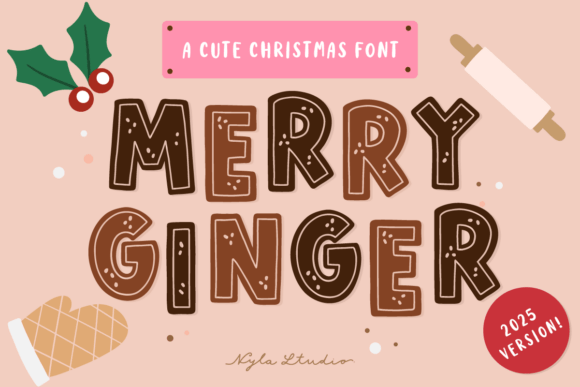
Merry Ginger is a gingerbread-inspired decorative font with soft rounded edges, gentle flourishes, and subtle cookie-like texture in its letterforms. Think warm cinnamon, crisp icing lines, and the handmade charm of a vintage Christmas card—but rendered with clean vector precision. It’s playful without being childish, nostalgic without feeling dated, and decorative without sacrificing legibility at practical sizes. That balance is why it shines across physical and digital products alike.
I use Merry Ginger most often for short, high-impact text: product names on candle labels, shop signage, greeting card headlines, and sticker phrases like “Joyful & Jolly” or “Bake With Love.” Its generous x-height and open counters mean it cuts cleanly on Cricut and Silhouette machines—even at 0.25" tall on small gift tags. For printed cards or mug wraps, I’ve tested it down to 14pt with excellent readability—especially when paired with ample spacing and a solid background.
It’s especially effective on natural materials: kraft paper tags, cream-colored cardstock, linen-finish invitations, and matte ceramic mugs. The font’s gentle contrast and friendly weight lend warmth to minimalist packaging and farmhouse-style signage. I recently used it for a set of holiday cookie box labels—paired with a thin sans serif for ingredient lists—and customers commented on how “cozy yet polished” the branding felt.
Merry Ginger works beautifully in layered designs too. As a display font, it anchors posters, wall art prints, and social media graphics for holiday markets. When cut as a vinyl decal for wooden signs or acrylic ornaments, its outlines hold up crisply. And because it’s designed with consistent stroke width and balanced proportions, it scales predictably—from 3" vinyl quotes on tote bags to 16" welcome boards at wedding venues.
For digital product creators, Merry Ginger adds instant seasonal personality to printable planners, advent calendars, and greeting card templates. Its visual rhythm supports quick scanning—great for checklist pages or gift tag sheets where users need to read and write quickly. I include it in my premium SVG bundles (with commercial license) because buyers consistently report strong conversion rates on listings featuring this font in mockups.
Readability matters most where function meets aesthetics—so here’s what I’ve learned through testing: avoid using Merry Ginger for full paragraphs or fine print. It’s not a body font. Stick to titles, names, slogans, and short decorative phrases. For longer text alongside it—like event details on an invitation or care instructions on a label—I pair it with a clean, neutral sans serif (think Montserrat Light or Inter Regular). That contrast creates hierarchy, improves scannability, and keeps your brand looking intentional.
When designing logos or monogrammed merchandise, I often combine Merry Ginger with a delicate script for names (“Emma & James”) or a sturdy serif for supporting text (“Est. 2020”). Its rounded forms soften sharper companions, while its warmth prevents overly clinical pairings. For retro-themed collections, I’ve even layered it with a condensed typewriter-style sans for contrast—and it holds its own without clashing.
Merry Ginger includes standard OpenType features: ligatures for common letter pairs (like “ff”, “fi”), stylistic alternates for letters like “a”, “g”, and “y”, and a full set of uppercase, lowercase, numerals, and punctuation. It supports Western European languages, making it reliable for shops serving international customers or bilingual holiday messaging. Files come in OTF and TTF formats—both fully compatible with design software, cutting machines, and web-based tools like Canva and Cricut Design Space.
One thing I always double-check before listing a printable or physical product: the commercial license. Merry Ginger is cleared for unlimited physical product use—so yes, you can stamp it on tea towels, embroider it onto pillows, print it on greeting cards, or cut it for vinyl decals sold on Etsy or at craft fairs. You can also bundle it into digital downloads, SVG kits, Canva templates, and client design work—as long as your license permits commercial redistribution (most premium decorative fonts do, but always verify the included license terms).
In my shop, Merry Ginger has helped unify seasonal collections—from peppermint-scented candle labels to “Merry & Bright” enamel pins. Customers recognize the style instantly, and repeat buyers tell me it feels “like part of the brand,” even though it’s just a font. That’s the quiet power of thoughtful typography: it shapes perception, builds familiarity, and quietly elevates handmade goods from “nice” to “noteworthy.”
If you’re building a holiday collection, refreshing your shop’s festive packaging, or launching a new line of printable wall art, Merry Ginger delivers both charm and reliability. It’s not just another Christmas font—it’s a working tool, designed for makers who value beauty *and* buildability.